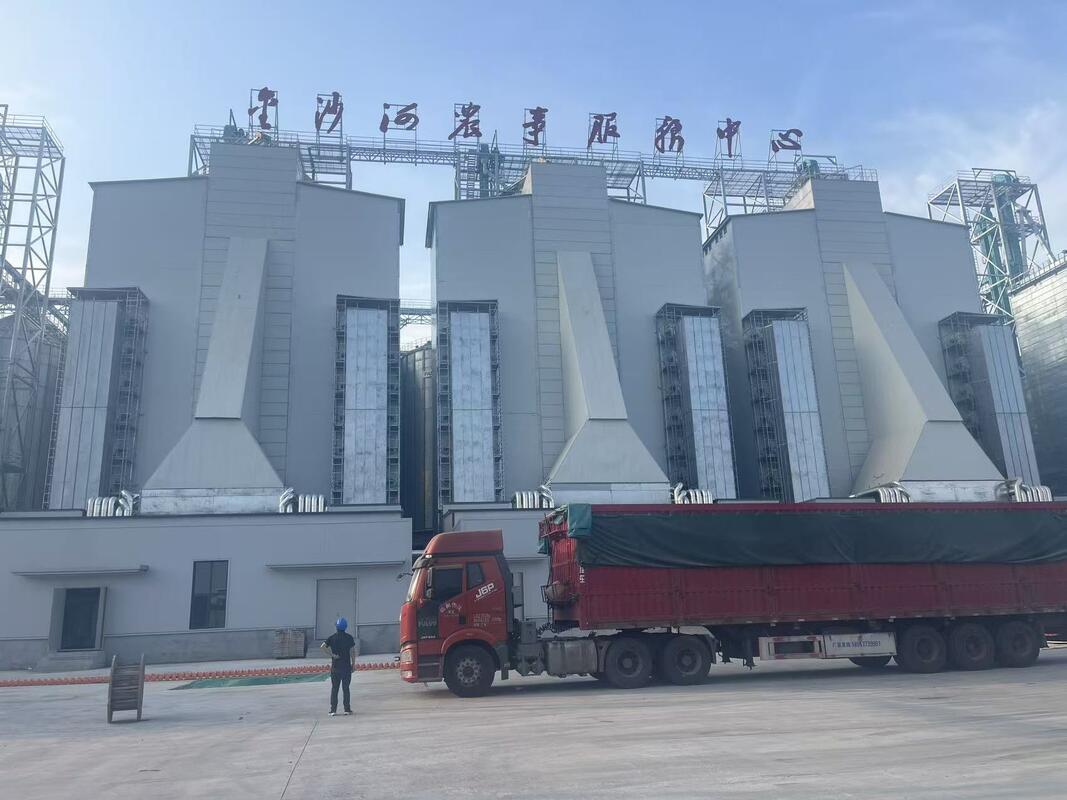
Highlight:
Grain Dryer Machine heat pump
, Grain Dryer Machine cost-saving operation
, Grain Dryer Machine high-efficiency performance
Applicable Grain Varieties: |
Rice, Wheat, Corn, Soybeans, Sorghum; |
Equipment Name: |
WGH Series Continuous Heat-Pump Drying Tower |
Structure Form: |
Vertical Multi-layer Tower; Continuous Concurrent-countercurrent Drying + Tempering + Cooling Process |
Specific Heat Consumption (heat-pump Working Condition): |
2800–4000 KJ/kg Water; High Coefficient Of Performance (COP), Far Lower Than Traditional Hot-blast Furnaces |
Discharge Method: |
Bottom Variable-frequency Continuous Grain-discharge Mechanism |
Continuous Operation Capability: |
24h Round-the-clock Uninterrupted Continuous Feeding, Drying And Discharge |
High‑efficiency heat pump operation cuts costs and boosts operational benefits
Cut Drying Costs by Clarifying the Energy Account
– Energy-Saving Solution of WGH Series Continuous Heat-Pump Drying Tower –
For large-scale grain processing, drying costs are often not a small amount: heat-source energy consumption, labour, maintenance and losses each directly squeeze profit margins. Among these costs, heat-source energy consumption accounts for the largest share, fluctuates the most, and deserves the most careful calculation. The WGH Series Continuous Heat-Pump Drying Tower developed by Zhengzhou Wangu Machinery Co., Ltd. is designed precisely to “get the drying energy account clear and save on it”: by replacing traditional fuel hot-blast furnaces with air-source heat pumps, it delivers higher energy efficiency and lower operating costs, helping users make every penny count.
1. Heat Source: The Heaviest Item in Drying Costs
Traditional drying generally relies on coal-fired, oil-fired or gas-fired hot-blast furnaces. Fuel prices fluctuate significantly, thermal efficiency is clearly affected by combustion conditions and maintenance levels, and fuel procurement, storage and transport add extra hidden costs. For grain depots and processing enterprises operating over the long term, fuel costs accumulate rapidly as output expands, becoming a machine that is “invisible yet continuously losing blood”.
To cut drying costs, the breakthrough lies in the heat source. Switching to a more efficient and controllable heating method usually delivers faster and more lasting results than compressing other links.
2. Why Heat Pumps Save Money
The WGH Series Continuous Heat-Pump Drying Tower uses air-source heat pumps as its core heat source. The working principle of a heat pump is not to “burn” electrical energy directly into heat, but to use one unit of electricity to drive the compressor and “carry” more heat from ambient air: electricity is only used to drive the cycle, while the heat output comes from the large amount of freely available low-grade thermal energy in the air. The heat pump’s coefficient of performance (COP) is therefore significantly higher than that of traditional electric heating and far better than the utilization efficiency of fuel hot-blast furnaces.
For users, with the same drying volume, heat-pump models deliver lower overall energy consumption and more economical unit drying costs. Moreover, electricity prices are more stable and transparent than fuel prices, so costs are predictable and no longer fluctuate sharply with fuel market conditions, making operating budgets more controllable.
3. Where the Savings Come From
Lower energy consumption. The heat pump extracts heat from the air, consuming far less electricity than traditional electric heating and fuel hot-blast furnaces, and significantly reducing specific heat consumption under equivalent moisture-reduction tasks.
Less labour. Heat-pump units have a compact structure and a high degree of automation; they require no dedicated furnace tending, coal feeding or ash cleaning. Paired with an intelligent control system, they greatly reduce on-site staffing and labour costs.
Less maintenance. With no fuel storage or transport, no flue-duct cleaning, and no dust-removal or desulphurization facilities, there are fewer operation-and-maintenance links, lower maintenance costs, and more worry-free long-term operation.
Fewer supporting investments. No additional fuel warehouse or environmental-treatment facilities are required, the footprint is smaller, supporting investment is reduced, and one-time investment is more focused.
4. Where the Profits Come From
What is saved is what is earned. Adopting a vertical multi-layer tower body, the WGH Series Continuous Heat-Pump Drying Tower enables feeding, drying and discharge to run simultaneously round the clock. With large processing capacity, unit-capacity costs are spread thinner. Combined with multi-layer low-temperature steady drying and on-line moisture monitoring, grain kernels remain intact, breakage is low, and drying is uniform and stable, reducing grain losses caused by overheating and shell cracking. Improved quality control is itself a real, tangible gain.
The hot-air temperature can be intelligently set according to grain variety and inlet moisture content, automatically matching the heat pump’s operating parameters so that every degree of heat is used where it is most needed, avoiding ineffective loss. After drying, grain requires no additional sun-drying and can be bagged and stored directly, shortening turnaround cycles and speeding up capital recovery. It can also switch quickly among different grains such as rice, wheat, corn, soybeans and sorghum – one machine for multiple uses – further amplifying the equipment’s usage value and return on investment.
5. Returns and Safeguards
The operating costs saved by energy-saving measures keep accumulating during continuous operation into considerable returns. The equipment is equipped with a thickened anti-corrosion tower body with an insulation layer, able to withstand wind and rain and suitable for long-term outdoor use, reducing replacement costs caused by environmental erosion. Products are manufactured in strict accordance with the ISO quality-management system. Before leaving the factory, each unit undergoes no-load commissioning, material-loading drying test and parameter calibration.

 Your message must be between 20-3,000 characters!