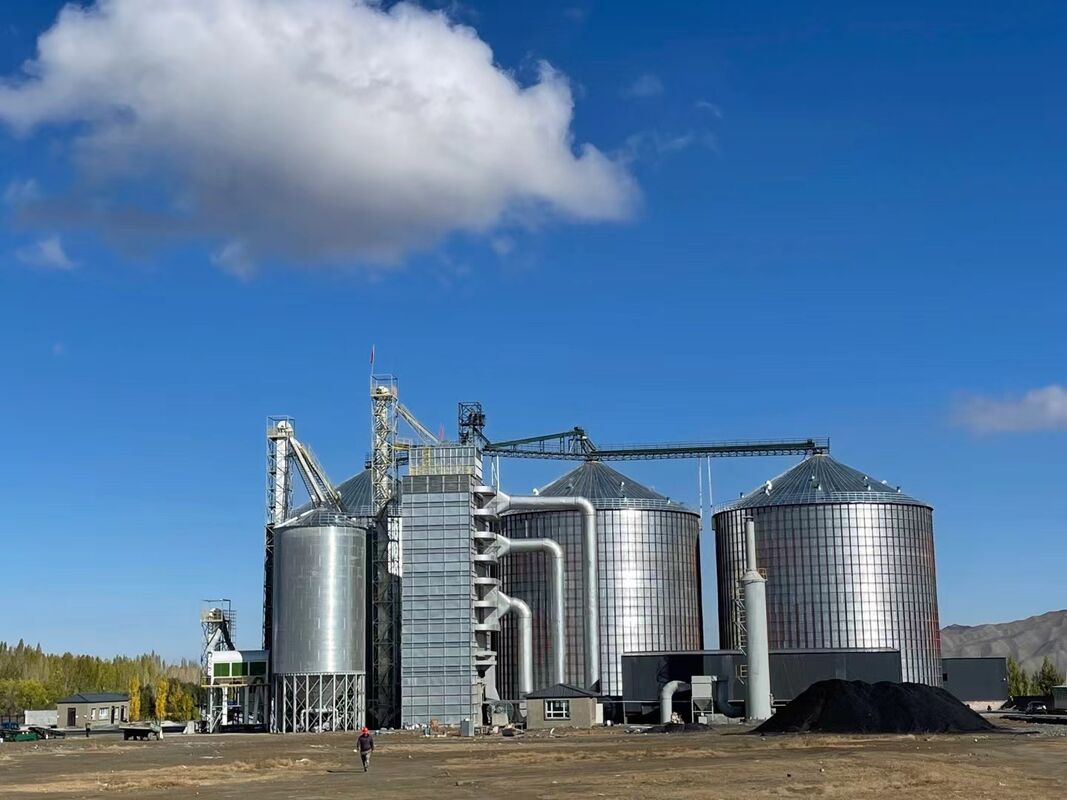
Highlight:
Corn dryer for latitude-specific harvest
, Grain dryer for corn harvest
, Corn dryer machine for grain
One tower engineered for your latitude your grain your harvest
Wangu has built drying towers for more than 25 years. We dismantled and studied what foreign models do well — tower segmentation, louver arrangement, hot-air distribution — then re-engineered each of them against dozens of real harvesting conditions across China, from the freezing northeast to the rainy south. The result combines an international design pedigree with three decades of field calibration.
That is why this tower never asks your grain, moisture or climate to adapt to it. Instead, our engineers take your latitude, humidity, crop and harvest moisture, then fix the process route — mixed-flow, co-current or co/counter-flow — together with the number of tower sections and the heat-source type, to configure the machine for you alone.
Working Principle: Two Loops and One Journey
Loop one is level self-balancing. At the low line the hot-air fan starts; at the middle line the discharge motor engages; at the high line feeding stops with an alarm. Discharge pulls the level back down and feeding resumes — inlet and outlet interlock automatically between the two lines, holding the system in dynamic balance without an operator.
Loop two is the heat path. Wet grain passes the evening feed unit into the holding section, then spreads into the ventilation ducts; hot air flows around the ducts and travels down with the grain into the drying section, where vaporized moisture exits through the exhaust louvers; dried grain is cooled to a safe temperature and leaves via the discharge hopper.
Master Specification Table
|
Parameter
|
Value
|
What it means for you
|
|
Model series
|
WGH100–1200
|
Six tower sizes, from township depots to port terminals
|
|
Capacity
|
100 to 2,000 t/d
|
Size by peak daily intake in harvest season
|
|
Drying range
|
5–20% per pass, up to 25%
|
No second pass even for very wet grain
|
|
Hot-air temp.
|
≤120°C, adjustable per crop
|
A temperature profile for every crop
|
|
Grain outlet
|
≤55°C
|
Cooled through, straight to storage
|
|
Evenness
|
Below 2%
|
Sampling will not fail on batch moisture spread
|
|
Breakage
|
Below 0.5%
|
The drying stage never downgrades your grade
|
|
Heat rate
|
About 5,800 kJ/kg of water
|
Typical measured value; fuel cost becomes predictable
|
|
Heat source
|
Coal, oil, gas, straw, rice husk, steam
|
Burn what is local and cheap
|
|
Operation
|
Continuous, 24-hour duty
|
No idle hour in a short harvest window
|
|
Install
|
Open-air installation
|
No building required, zero civil investment
|
|
Warranty
|
12 months
|
Remote support within 24 hours
|
One Tower, Six Crop Profiles
|
Crop
|
Parameter profile
|
Quality outcome
|
|
Maize
|
High airflow, fast removal, higher air temperature allowed
|
Very wet grain reaches safe moisture in one pass; no backlog
|
|
Paddy
|
Low air temperature, strict grain-temperature control
|
Checked cracks and broken rice; milling yield protected
|
|
Wheat
|
Balanced removal, batch-to-batch consistency
|
Gluten intact; fits both trade and storage
|
|
Soybean
|
Low temperature, slow gentle removal
|
Protein and seed coat intact; oil unoxidized
|
|
Rapeseed
|
Lower air temperature, slow discharge
|
Seed coat whole; oil yield unaffected by drying
|
|
Seed grain
|
Low temperature plus full tempering
|
Germination rate preserved; seed value kept
|
Seven Features Behind the Figures
◆ Powerful dewatering — 25 percentage points in one pass.
◆ Wide adaptation — six crops, six fuels, every latitude.
◆ Dried through — full tempering, unevenness below 2%.
◆ Dried clean — indirect heat exchange, no flue gas ever touches the grain.
◆ Fuel-efficient — measured heat rate of about 5,800 kJ/kg of water.
◆ Continuous and stable — 24-hour mechanized operation.
◆ Well-managed — central automatic control, one operator per tower.
Frequently Asked Questions
Q: Can the tower stand fully outdoors in rain or snow?
A: Yes. The tower body, platforms and railings are designed for open-air duty and the electrical parts are protected for year-round operation.
Q: Can it dry oil crops such as rapeseed and sunflower seed?
A: Yes. Oil crops run on a lower air-temperature, slower-discharge curve to protect the seed coat and oil quality.
Q: How is drying uniformity guaranteed?
A: Multi-layer louvers distribute air evenly and the tempering section equalizes moisture, keeping unevenness below 2% across the whole batch.
Q: What if my local fuel differs from yours?
A: All six heat sources can be fixed at ordering, and dual-fuel configurations (for example coal plus biomass) are available for flexibility.
Q: How long from order to first dried grain?
A: Typically 2 to 3 months including production and sea freight, plus 7 to 15 days on site for erection and commissioning before trial production.
Q: How about spare parts and after-sales service?
A: A seasonal wear-parts package ships with the machine; later parts come direct from the factory with English manuals and video guidance, and remote support responds within 24 hours.

 Your message must be between 20-3,000 characters!