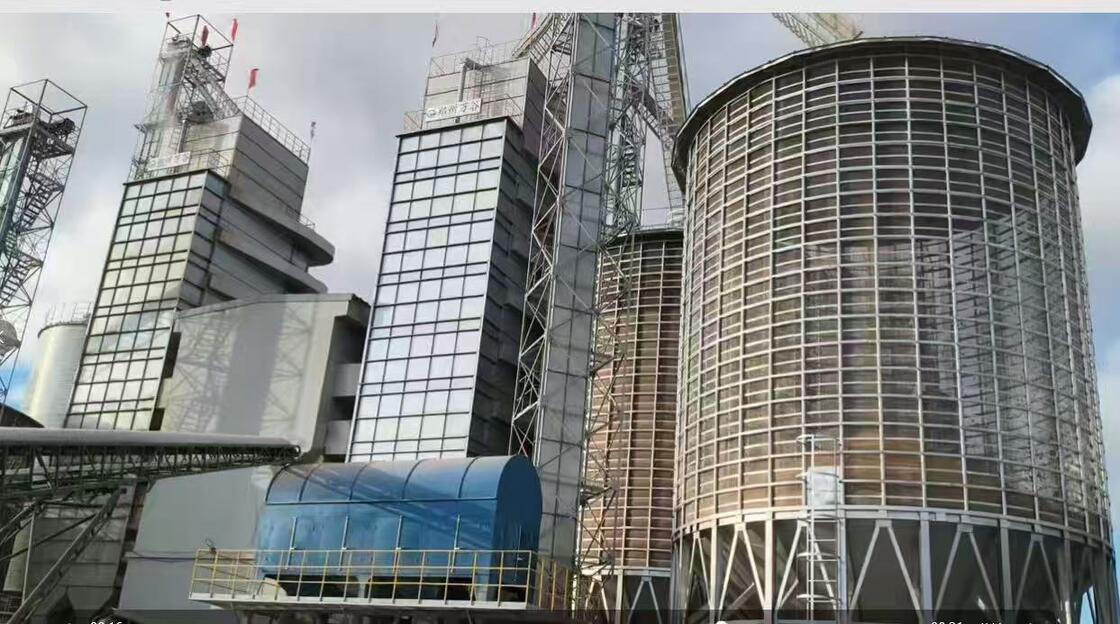
Highlight:
corn dryer machine fast dewatering
, counter-flow corn dryer machine
, corn dryer machine quality lock
Co-current takes the water off fast counter-flow locks the quality in
Why We Build the Co/Counter-Flow Combination
The first hours in the tower are the most delicate: grain is at its wettest, and the wrong airflow direction means either under-drying or over-drying. The co/counter-flow design uses both directions for what they do best. Upstream, hot air travels with the grain while it is still wet — the largest temperature difference removes surface water fast without heat damage. Downstream, air moves against the progressively drier grain, finishing the drying gently while squeezing the last usefulness out of every degree. Two directions, one tower, handing over like relay runners — speed and stability that single-flow dryers cannot match.
Working Principle: Full but Never Overflowing
Three level switches keep watch over the grain column. Wet grain enters through the spreading unit; when the level touches the lower switch, the hot-air fan energizes. At the middle switch, a sensor sends the signal and the discharge motor starts. At the upper switch, an alarm sounds and feeding stops. Discharge continues, the level slowly falls, and at the middle switch feeding resumes. The cycle repeats around the clock, fine-tuned by feed-rate adjustment, so the tower stays full without spilling and emptying without running dry — always grain to dry, always room to feed.
Inside: the holding section absorbs surges, the air-distribution section spreads grain evenly into the ventilation tubes; hot air wraps around the tubes and travels down with the grain into the drying stage, where moisture vaporizes and leaves through the exhaust louvers; the dried grain cools to a suitable temperature and exits through the discharge section and hopper, ready for the store.
What Each Stage Takes Charge Of
|
Stage
|
Airflow and mission
|
Outcome
|
|
Co-current stage
|
Hot air descends with the grain; peak air temperature meets the wettest grain
|
Fast removal — up to 25 percentage points in a single pass
|
|
Counter-flow stage
|
Air rises against the grain; gentle finishing, heat used stage by stage
|
Even deep drying with higher heat utilization
|
|
Counter-flow cooling
|
Ambient air sweeps upward through the grain, exchanging heat in reverse
|
Grain leaves near ambient temperature, ready for the silo
|
Six Key Features
◆Up to 25 percentage points per pass: freshly harvested wet grain reaches safe moisture in one run, no re-handling.
◆ Wide adaptability: any climate, and switching among maize, paddy, soybean, wheat, sorghum or rapeseed means changing parameters, not machines.
◆Dried even and cooled through: tempering equalizes moisture inside each kernel, and grain leaves at near-ambient temperature with moisture on spec.
◆Clean medium: heat is delivered indirectly, so combustion products never reach the grain — normal colour, no taint.
◆ Continuous and dependable: mechanized operation all season long, all-steel outdoor structure, running round the clock with no drying shed.
◆Central automatic control: feeding, hot air and discharge managed from one panel — one operator runs the whole line.
Five Practical Payoffs
◆No backlog in peak season: continuous in and out, two shifts through harvest, grain dried as it arrives instead of piling up on the yard.
◆Quality is money: tempering and cooling hold down cracking and breakage — head rice for paddy, grade for maize, germination for seed lots.
◆A fuel bill you can predict: six heat sources matched to local prices, energy-saving design cutting the heat rate — costable before the season starts.
◆ Fewer hands, fewer worries: level switches manage flow automatically, the PLC runs the line, one operator on watch, and no shed to build.
◆ Straight from tower to bin: grain near ambient temperature and on-spec moisture — no cooling turns, no re-piling, no second-loss window.
Crops and Fuels at a Glance
Crops: maize wants speed,paddy wants evenness, soybean wants low temperature, seed lots want germination — each has a preset parameter curve in the PLC.Fuels: burn coal where coal is cheap, gas where gas is piped, straw and husk where the fields provide them,or tap an existing boiler for steam heat. Send us your local fuel prices and we will work out which option saves you the most.

 Your message must be between 20-3,000 characters!