Highlight:
continuous corn drying tower
, low-temperature corn dryer machine
, corn drying tower with tempering
Daily Capacity: |
100–2000 T/day |
Target Moisture: |
13–14% For Safe Storage |
Moisture Removal Per Pass: |
Up To 25 Percentage Points |
Drying Medium: |
Clean Air Via Indirect Exchange; No Flue Gas In The Grain Column |
Heat Source: |
Coal / Oil / Gas / Straw / Rice-husk Furnaces, Or Steam Heat Exchange |
Process Layout: |
Parallel + Counter-flow Stages Proportioned For The Maize End Use |
Discharge: |
Multi-group Variable-frequency Six-blade Rollers With Grain-temperature Limiting |
Control: |
Hree Level-switch Self-balancing Plus PLC; One Operator Per Line |
Installation: |
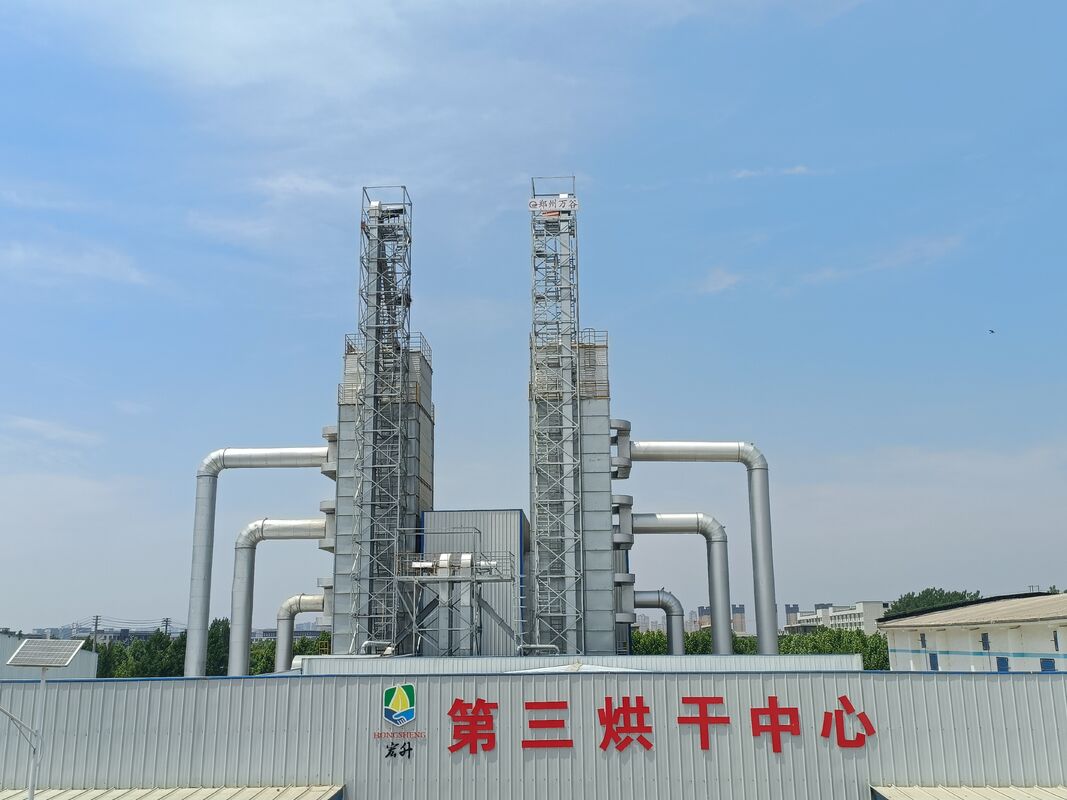
Open-air All-steel Structure, Insulated Hot Parts, Dust-explosion Design |
Continuous Corn Drying Tower with Low-Temperature Tempering
Why maize is the toughest grain to dry?
Many buyers have dried wheat or paddy first and assume another crop is just another parameter set — maize quickly proves otherwise. Four difficulties stack up: the highest harvest moisture of all cereals (new-season corn commonly sits at 28–35%, nearly double wheat); a large, oil-rich germ that cracks and suffers heat damage when heated too hard, dragging the grade down; a loose kernel structure that picks up and releases moisture fast, so drying too hard causes stress cracking and drying too slowly causes surface condensation; and rapid self-heating in the heap — wet corn left piled even briefly warms and cakes, and mould and mycotoxin risks follow.
These four facts settle one question: a maize tower is not another tower scaled up — the process staging, the air-temperature curve and the discharge rhythm must all be re-engineered around maize. That is exactly why we offer this dedicated maize edition.
Racing mould: the harvest-season window
The maize harvest is intensely concentrated, and trucks queuing in front of the drying line are a yearly sight. The queue itself is not the danger — every loaded truck of wet corn in it is quietly warming up. Without aeration in the receiving yard, heating and caking of high-moisture grain can develop within days; once mouldy kernels appear, the price and permitted use of the whole lot change.
A Wangu parallel/counter-flow line is built to digest that queue: 100–2000 tonnes per day, continuous intake and continuous discharge, running round the clock; with wet-corn buffer bins and aeration, trucks unload as they arrive and the grain is dried and binned before mould can start. The season no longer ends with trailers of wet grain being re-handled, but with dry bins sealed one after another.
Four process tunings made for maize
-
The parallel-flow stage meets the wettest grain with a warmer air stream and cuts the 28–35% harvest moisture down fast; the counter-flow stage then finishes with cooler air rising gently against the nearly dry kernels, equalising core and surface moisture — hot air is spent only on the wettest grain, cool air guards the finish.
-
Maize releases stress more slowly than wheat, so we weight the section layout towards tempering: after every heating pass the kernels get a full rest, and crack and breakage rates fall (a typical 4-drying / 4-tempering layout, adjusted per project).
-
Multi-group, variable-frequency six-blade rollers meter grain out evenly across the full tower section, and residence time is stretched to match the moisture load — slow discharge is how maize keeps its grade; extra capacity comes from parallel towers, never from rushing the outlet.
-
Discharge-grain temperature is monitored live and held within about 8 °C above ambient (typical control value). Kernels leave the tower near ambient temperature and go straight into the bin — no spread-cooling step required.
Five lines of defence for maize quality
Drying is the last gate for maize quality. The five attributes buyers actually price are each defended inside the tower:
|
Line of defence
|
What it targets
|
How we handle it
|
|
1. Scorching
|
Overheated air discolours the pericarp
|
Air temperature is graded by end use with automatic limits, interlocked with the furnace
|
|
2. Cracks & breakage
|
Thermal stress cracks kernels and adds fines
|
Generous tempering, cool counter-flow finishing and slow metered discharge
|
|
3. Moisture spread
|
A lot dries unevenly and re-wets locally in storage
|
Even grain spreading and staggered air boxes keep moisture spread within 2% (typical acceptance)
|
|
4. Heat damage
|
Heat-damaged kernels count as damage and cut the grade
|
Discharge-temperature limiting with prompt exhaust of humid air
|
|
5. Mould & mycotoxins
|
Wet grain heating and moulding in the yard
|
Continuous processing eliminates yard waiting; grain leaves the tower at safe storage moisture
|
More than a tower: the complete maize line
The tower is only the middle of a maize line. Wangu supplies the whole plant on a turnkey basis: upstream, scalping and cleaning equipment removes caked and mouldy lumps and stalk fragments before the tower; the elevating section uses bucket elevators fitted with explosion vents and abrasion-resistant spouting to meet dust-explosion requirements; downstream, the discharge feeds belt conveyors and a battery of steel silos where dried grain is weighed and sealed in; the furnace and all fans and valves answer to one PLC, manned by a single operator in the control room. From truck arrival to sealed bins, no step needs manual handling.
About Wangu
Founded in 1998, Zhengzhou Wangu Machinery Co., Ltd. is a state-recognised high-tech enterprise with nearly three decades dedicated to grain drying and storage equipment — recirculating dryers, continuous drying towers, mixed-flow dryers, steel silos and complete cleaning and conveying plants — operating across China’s grain belts and exported worldwide.
Send us your seasonal harvest moisture, daily intake and site plan, and we will return a maize-line quotation covering the process scheme, layout and fuel calculation.

 Your message must be between 20-3,000 characters!